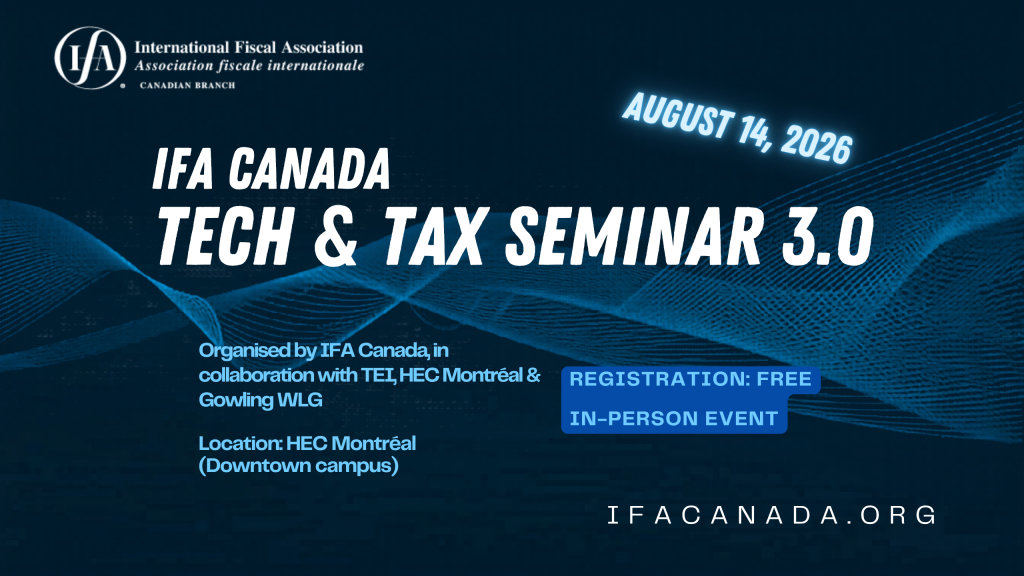

IFA Canada Tech & Tax Seminar 3.0

Organized by IFA Canada (in collaboration with TEI, HEC Montréal, and Gowling WLG)

SCHEDULE:

Date: Friday, August 14, 2026

  • Breakfast and Networking: starting at 7:30 am
  • 1st Panel: 8:00 am to 9:15 am
  • Break: 9:15 am to 9:40 am
  • 2nd Panel: 9:40 am to 10:40 am
  • Break: 10:40 am to 11:00 am
  • 3rd Panel: 11:00 am to 12:00 pm


Registration
Free

Format: In-person only

Language: Presented in English

DESCRIPTION

We are pleased to return this year in Montréal with a new edition of our Tech & Tax Seminar, building on the enthusiasm and success of last year’s event. As digital transformation accelerates across the tax landscape, this year’s program examines how emerging technologies are reshaping both corporate tax functions and tax administration worldwide.

The 2026 seminar takes a practical and forward‑looking approach to the integration of automation, data analytics, and artificial intelligence in tax practice. Through three complementary panels, we explore how organizations can streamline processes, reduce friction points, and manage growing volumes of data; how tax authorities are adopting advanced tools to modernize compliance and audit functions; and how AI may ultimately evolve from a resource to a genuine thought partner in the profession.

Designed for in‑house tax professionals, tax lawyers, accountants, professors, and students, the seminar brings together academics and practitioners. Participants will gain insight into current applications of automation and AI, emerging international trends, and the strategic and human considerations essential for responsible adoption.

LOCATION

HEC Montréal, Downtown Campus | Get Directions

Édifice Hélène Desmarais
501, rue de la Gauchetière Ouest
Montréal (Québec) H2Z 1Z5

A.335 Amphithéâtre Rachelle et Alain-Paris

AGENDA

1st Panel: The In-House Perspective

2nd Panel: Government and Tax Authorities: The Global Landscape

3rd Panel: Vision 2040: The Future of AI-Human Partnership

Moderators

  • Laura Gheorghiu – Partner and Practice Group Leader, Tax at Gowling WLG (Canada) LLP | Vice-President at IFA Canada
  • Josephine L. (Josie) Scalia – VP, Head of Global Tax at CAE
  • Raphaël Clément – Lecturer, HEC Montréal


Speakers

  • Cheria Coram – Director, Tax Technology & Data Enablement at Starbucks
  • David Gielty – Director, Tax Operations, Data and Automation at Atkinsrealis
  • Hersh Joshi – Managing Director, Corporate Affairs at Ontario Teachers’ Pension Plan
  • Luis Perez – Director, Global Tax Ai Automation at Dell Technologies
  • Pedro Frantz – Federal Revenue Service Tax Auditor & Head, Centre of Excellence in Artificial Intelligence at the Brazilian Federal Revenue Service
  • Pramod Kumar – Former Vice President at the Indian Income Tax Appellate Tribunal
  • Brigitte Muehlmann – Professor, Division of Accounting and Law at Babson College
  • Anthony Niblett – Professor of Law at University of Toronto | Co-Founder at Blue J Legal
  • Lionel Nobre – Vice President of Latin America Tax at Dell Technologies
  • Maniek Santokhi – Lecturer, Computational Science of Taxation at Maastricht University

Volunteers

  • Yasmine Hannoush – Law Clerk, Tax at Gowling WLG (Canada) LLP
  • Eve-Marie Mercier – Tax Manager at AtkinsRéalis and lecturer at HEC Montréal
  • William Prévost – Tax Advisor at Raymond Chabot Grant Thornton and lecturer at HEC Montréal

CPD

Continuing Professional Development Information

QUEBEC

For 
Québec lawyers, this program may qualify for 3.25 CPD hours under the Barreau du Québec’s Mandatory Continuing Legal Education (MCLE) framework.
The Barreau du Québec requires all active members to complete at least 30 hours of CPD over a two-year period, including a minimum of 3 hours related to ethics, professional conduct, or professional practice, from activities recognized by the Barreau. (The current reference period began on April 1, 2025 and ends on March 31, 2027.) Members must report completed activities, with supporting proof of registration and participation, in their online training record—accessible via the member portal—by March 31 of the final year of the reference period. No separate application for recognition is required. 

Pour les avocats du Québec, ce programme peut être admissible à 3.25 heures de DPC dans le cadre du régime de formation continue obligatoire (FCO) du Barreau du Québec.
Le Barreau du Québec exige que tous les membres actifs complètent un minimum de 30 heures de DPC sur une période de deux ans, dont au moins 3 heures portant sur l’éthique, la déontologie ou la pratique professionnelle. Les activités doivent être déclarées dans le dossier de formation en ligne, avec les pièces justificatives requises, au plus tard le 31 mars de la dernière année de la période de référence.


ONTARIO

For 
Ontario lawyers, this program is eligible for up to 3.25 substantive hours of CPD.

“Substantive hours” refer to educational activities that increase a lawyer’s or paralegal’s professional knowledge and skills related to substantive or procedural law, legal theory, and the practice of law. These hours can include learning in areas such as litigation, legal research, negotiation, drafting, and other legal competencies. Substantive content does not require accreditation by the Law Society of Ontario (LSO), providing flexibility in how Ontario lawyers and paralegals fulfill this component of the CPD requirements. Ontario lawyers and paralegals must complete all required CPD hours by December 31 each year and report them through the LSO Connect portal by March 31 of the following year. For details, see the LSO’s CPD Requirement page.


OTHER CANADIAN JURISDICTIONS

Lawyers in other Canadian jurisdictions may be eligible to claim continuing professional development (CPD) credit for this program in accordance with the requirements of their provincial or territorial law society. Participants should consult their governing body to determine eligibility and applicable reporting requirements.

Séminaire Tech & Tax 3.0 d’IFA Canada

Organisé par IFA Canada (en collaboration avec TEI, HEC Montréal et Gowling WLG)

Horaire

Date : Vendredi 14 août 2026

  • Déjeuner et réseautage : à partir de 7 h 30
  • 1er panel : 8 h 00 à 9 h 15
  • Pause : 9 h 15 à 9 h 40
  • 2e panel : 9 h 40  à 10 h 40
  • Pause : 10 h 40 à 11 h 00
  • 3e panel : 11 h 00 à 12 h 00


Événement gratuit


Format :
en présentiel seulement
Langue : Présentation en anglais

DESCRIPTION

Nous sommes heureux d’être encore à Montréal cette année pour la prochaine édition de notre Séminaire Tech & Tax. Alors que la transformation numérique s’accélère en fiscalité, le programme de cette année examine comment les technologies émergentes redéfinissent à la fois les fonctions fiscales des entreprises et des administrations fiscales à l’échelle mondiale. L’édition 2026 adopte une approche pratique et prospective de l’intégration de l’automatisation, de l’analyse de données et de l’intelligence artificielle dans la pratique fiscale. À travers trois panels complémentaires, nous explorerons :
  • comment les organisations peuvent rationaliser leurs processus, réduire les points de friction et gérer des volumes croissants de données ;
  • comment les autorités fiscales adoptent des outils avancés pour moderniser les fonctions de conformité et de vérification ; et
  • comment l’intelligence artificielle pourrait éventuellement évoluer d’une simple ressource vers un véritable partenaire intellectuel au sein de la profession.
Destiné aux fiscalistes en entreprise, avocats fiscalistes, comptables, professeurs et étudiants, le séminaire réunit des chercheurs et des praticiens. Les participants obtiendront un aperçu des applications actuelles de l’automatisation et de l’intelligence artificielle, des tendances internationales émergentes ainsi que des considérations stratégiques et humaines essentielles à une adoption responsable.

LIEU

HEC Montréal, Campus du centre-ville | Itinéraire Édifice Hélène Desmarais 501, rue de la Gauchetière Ouest Montréal (Québec) H2Z 1Z5 Salle A.335 – Amphithéâtre Rachelle et Alain-Paris

AGENDA

  • 1er panel : La perspective des fiscalistes en entreprise
  • 2e panel : Gouvernements et administrations fiscales : panorama mondial
  • 3e panel : Vision 2040 : l’avenir du partenariat IA-Humain

Modérateurs

  • Laura Gheorghiu – Associée et cheffe du groupe de pratique, Fiscalité, chez Gowling WLG (Canada) S.E.N.C.R.L., s.r.l. | Vice-présidente de l’IFA Canada
  • Josephine L. (Josie) Scalia – Vice-présidente, responsable mondiale de la fiscalité chez CAE
  • Raphaël Clément – Chargé de cours, HEC Montréal

Conférenciers

  • Cheria Coram – Directrice, Technologies fiscales et valorisation des données, Starbucks
  • David Gielty – Directeur, Opérations fiscales, données et automatisation, AtkinsRéalis
  • Hersh Joshi – Directeur général, Affaires corporatives, Régime de retraite des enseignantes et des enseignants de l’Ontario
  • Luis Perez – Directeur, Automatisation mondiale de l’IA en fiscalité, Dell Technologies
  • Pedro Frantz – Vérificateur fiscal à la Receita Federal du Brésil et chef du Centre d’excellence en intelligence artificielle de la Receita Federal du Brésil
  • Pramod Kumar – Ancien vice-président du Tribunal d’appel de l’impôt sur le revenu de l’Inde
  • Brigitte Muehlmann – Professeure, Division de la comptabilité et du droit, Babson College
  • Anthony Niblett – Professeur de droit à l’Université de Toronto | Cofondateur de Blue J Legal
  • Lionel Nobre – Vice-président, Fiscalité – Amérique latine, Dell Technologies
  • Maniek Santokhi – Chargé de cours, Science computationnelle de la fiscalité, Université de Maastricht

Bénévoles

  • Yasmine Hannoush – Technicienne juridique, Fiscalité, Gowling WLG (Canada) S.E.N.C.R.L., s.r.l.
  • Eve-Marie Mercier – Gestionnaire en fiscalité chez AtkinsRéalis et enseignante à HEC Montréal
  • William Prévost – Conseiller en fiscalité chez Raymond Chabot Grant Thornton et enseignant à HEC Montréal